
10 Fun Facts About Manatees in Crystal River
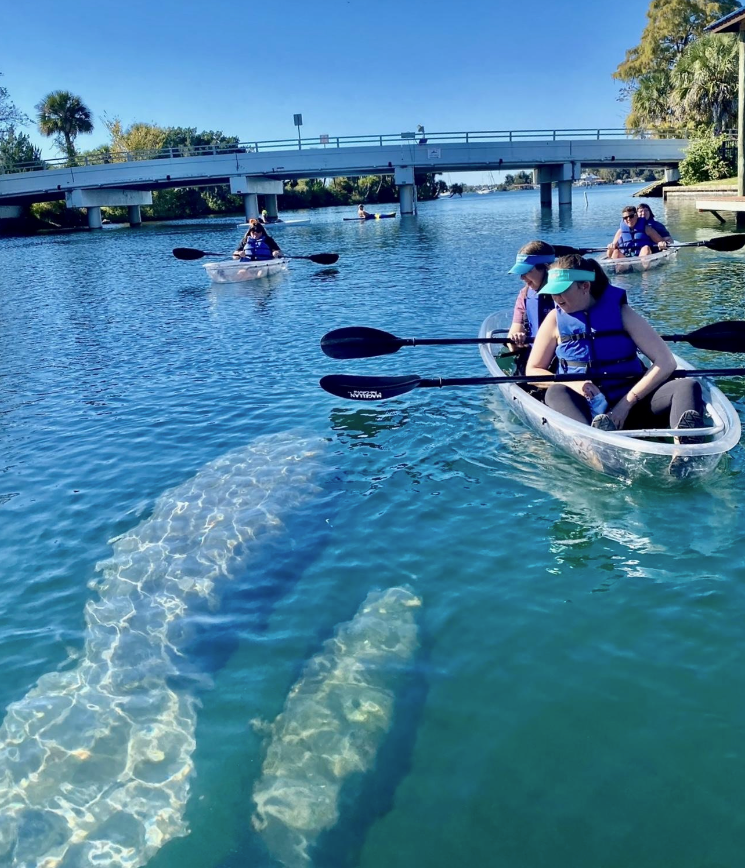
Manatees are one of the most unique animals in the world. How can a creature be so large, yet so gentle and harmless!? Let’s learn more about these awesome sea-potatoes to get you ready for your Manatee Season Tour at Crystal River! and you are excited to finally be able to meet our adorable manatee friends!
1) Manatees Are Vegetarians
That’s right! Manatees are herbivores, meaning that they only eat plant material. Their diet mainly consists of seagrass, but they will also munch on other aquatic plants as needed. Since they are so large (adults typically weigh over 1,000 lbs!) they need to eat tons of vegetation! They can easily intake 100 lbs of plant material just in a single day!
2) Marching Molars
Like every good herbivore, their teeth are specialized for grinding up the plants to get it ready to digest. As they’re eating, they may intake gritty sand and other material that easily wears down their teeth. This means that they are almost constantly replacing their teeth–but in a very unique way! Instead of their teeth growing up from their jaw, as human teeth grow, their growth starts at the back of their mouth and pushes their teeth horizontally out! This means their older teeth are at the front of their mouth and their more mature teeth are set back.
3) Blinking Like A Camera
Manatees actually do not have eyelids! Instead, they have circular muscles around their eyes that allow them to close their eyes similar to the aperture of a camera. This means that they squeeze together in a circular motion!
4) Dense Bones
Manatees have very dense bones because they don’t contain bone marrow like many other species! This is known as having pachyostotic bones. This is thought to be an adaptation to their environment. It’s said it helps with buoyancy and allows them to drop to grassy sea beds to grazing. (Think of a blimp!) Instead of creating red blood cells through bone marrow all throughout their body, they create it through their sternum where bone marrow is found.
5) Weird Fish Or What?
Manatees live in the water, but are NOT fish! They are actually a marine mammal (just like orcas, whales, and dolphins!) They still require oxygen to breathe, have hair, give birth to live young, and feed their young with milk! Oftentimes on our clear kayak tours,our guests will witness wild manatee moms nursing their babies, even while swimming. This is a favorite wildlife encounter for our paddlers who are also moms!
6) World Travelers
Manatees–specifically the West Indian manatee, or its subspecies the Florida manatee- are most well known for gathering in the warm spring waters of Florida during the winter months. But when the Gulf is warm enough for them to venture back out, where do they go? Many places, actually! Some journey further north and have been found as far as the coast of Massachusetts. Others go south and visit the Caribbean or South America!
7) No Natural Threats
Despite manatees being incredibly gentle and rarely showing any signs of aggression, that doesn’t make them easy targets for predators! They actually have no natural predators in the wild, only being affected by boat strikes, pollution, and other human-caused effects.
8) Modes Of Transportation
Manatees typically move at a leisurely pace, only going about 3 to 5 miles per hour when cruising. However, they will move fast in short bursts when needed! They can be found to have high speeds of 20 miles per hour! While swimming, they use their flippers to steer themselves, while their paddle-like tail propels them forward. Additionally, their tail can be used as an anchor to root themselves in place to stay still while they enjoy their food.
9) Hold Your Breath!
Manatees need to breathe oxygen, just like us, so when they are underwater they are actually holding their breath! They typically hold it for 3 to 5 minutes, depending on their energy exertion and individual ability. However, they are known to be able to hold their breath for up to 20 minutes while resting!
10) Important Conservation For Our Friends
Manatees are currently considered threatened, with their populations facing instability due to continued pressure from human threats. They have several protections to help them along, including laws and actions under the U.S. Fish and Wildlife Service and the Florida Manatee Recovery Plan. This allows for special protections in 13 counties in Florida, where there is a focus on reducing manatee and boat collisions. However, every person has a responsibility to keep our manatee friends safe by learning more about them and respecting them as wild animals!To see these amazing animals in the wild in the most responsible and ethical way, get in a clear kayak! Our manatee tours in Crystal River or Chaz River are the best areas to encounter these incredible creatures. You will learn so much more on your tour from our incredibly knowledgeable guides, see these giants in their natural habitat, and make memories that will last a lifetime!
Sources & Credit:
https://www.fws.gov/species/manatee-trichechus-manatus
https://kids.nationalgeographic.com/animals/mammals/facts/west-indian-manatee